

Two different dentists recently told me I have a tooth with a large defect inside. Both were surprised I wasn’t experiencing severe pain. I sought a second opinion last week because the diagnosis concerned me, but the second dentist agreed with the first.
Last Thursday, I began feeling a mild pulsing sensation in my gums around the tooth, and I’m wondering if an infection is spreading. The dentists told me that without treatment, the tooth could eventually break apart and become more painful than ever.
Is it better to save a tooth like this with a root canal, or are extraction and an implant more efficient? I’m scheduled to receive an implant for the opposing upper tooth due to root canal failure and a tooth post that kept falling out. I want to get out of the root canal cycle if possible. Thanks. Jalynn
Jalynn,
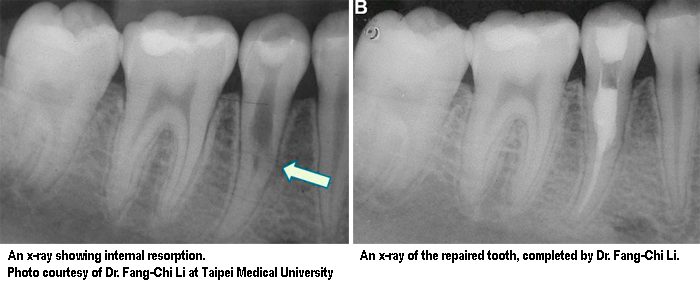
Based on your description, two dentists have confirmed the diagnosis. What may appear on an X-ray as a cavity inside the tooth is often internal resorption rather than traditional tooth decay. The condition is usually associated with inflammation of the pulp tissue, although the exact cause is not always known.
What Is Internal Resorption?
Internal resorption is a rare condition in which a tooth begins to break down from the inside.
Is Root Canal the Right Treatment for Internal Resorption?
In many cases, yes, a root canal is the preferred treatment. When internal resorption is identified before extensive damage occurs, root canal therapy can remove the inflamed tissue and stop the process from progressing. The goal is generally to preserve a patient’s natural tooth if it can be done predictably and safely. Many teeth treated at this stage can be preserved and function well for years.
Your concerns are understandable if you’ve had a failed root canal before. Some patients with failed root canals choose extraction and replacement with a dental implant instead of repeat root canal treatment. However, we encourage choosing the option that offers the best long-term outlook and that you feel comfortable with.
When Does Internal Resorption Become More Serious?
Internal resorption becomes more serious when it breaks through the root. If a perforation develops, repairing the tooth is considerably more complex. It’s a challenge to seal the perforation and deal with the loss of internal tooth structure. As more of the tooth is destroyed, the risk of fracture increases.
If the remaining tooth is too weak to provide a reliable long-term result, consider replacing it with a dental implant rather than attempting a repair with an uncertain outcome.
The Monroe, Louisiana, dentists at Bayou Dental Group sponsor this post. Please read why patients say Dr. Finley and his team provide the best dental care in Monroe.