

I had a root canal on a front tooth in 2024. It wasn’t painful, and I was happy with the treatment. My dentist offered to place a veneer for a low price, but I chose to wait.
In February 2025, I noticed that the tooth had started to discolor. I didn’t realize this could happen after a root canal. Later, another general dentist placed a porcelain crown. I was surprised by how much she had to file down my tooth, leaving only a small fang underneath the crown.
The crown is stable, but I’m concerned about what will happen if it needs replacement in the future. Did I really need a crown, or could the tooth have been treated more conservatively with a veneer? Thanks. Ezra from TN
Ezra,
Your dentist’s recommendation was consistent with a traditional approach to restoring root canal-treated teeth. Dental schools have long taught that teeth needing root canal treatment often need crowns afterward, because they may be more susceptible to fracture.
Although we cannot say you were misled, we understand why seeing your front tooth reduced for a crown was upsetting. Crown preparation can remove a significant amount of natural tooth structure.
The question is whether that much reduction was necessary. Many teeth need root canal treatment because they already have extensive decay, a large filling, or a fracture. Based on your description, your front tooth may not have had that much damage. Trauma alone, such as a previous blow to the tooth, can sometimes damage the pulp and eventually lead to root canal treatment even when much of the tooth remains intact.
Do Front and Back Teeth Need the Same Protection?
Front and back teeth experience different forces, so they do not necessarily require the same type of restoration.
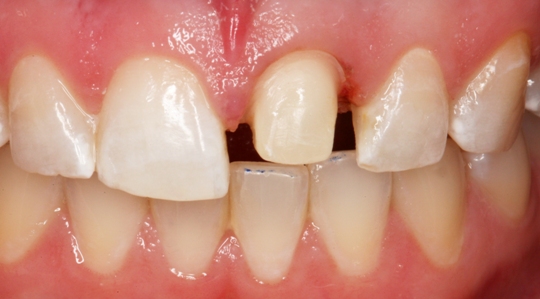
Front tooth shaved down to accommodate a crown
Back teeth contain cusps that absorb heavy chewing pressure. When you bite, those forces can push the cusps apart. If a tooth is weak, it may split between the cusps. A crown surrounds the tooth and can help prevent a fracture.
Front teeth face lateral, or sideways, forces. The lower front teeth push forward against the upper teeth, while the upper teeth push backward against the lower teeth. Impact to your mouth can also place substantial lateral pressure on an upper front tooth. A vulnerable front tooth may be more likely to snap near the gumline than to split like a molar.
Even a conservative crown preparation removes about a millimeter of tooth structure. Removing the structure reduces the thickness at the tooth’s neck, which can affect its ability to withstand sideways forces.
How Could a Veneer Help Preserve the Tooth?
A veneer can be much more conservative because it primarily covers the front surface of the tooth. When the tooth is otherwise structurally sound, this approach lets the dentist preserve more of the natural enamel and underlying tooth.
Preparing a front tooth for a porcelain veneer may require removing only about half a millimeter of enamel from the facial surface. However, restoring a darkened root canal tooth with a veneer can be technically demanding because the porcelain is thin. The dentist and laboratory technician must carefully control the underlying color to hide the darker tooth while creating a veneer with natural translucency, color, and shape.
That requires cosmetic training and experience that not every general dentist routinely uses. A crown may therefore be a more familiar and predictable treatment for many dentists.
Is Tooth Discoloration After a Root Canal Preventable?
Careful treatment of the inside of a front tooth can sometimes delay—but not entirely prevent—discoloration for years. The darkening is not necessarily caused by the tooth becoming dry after root canal treatment. Materials and remnants left within the crown can contribute significantly to the color change.
A conservative approach may include carefully removing root canal filling materials from inside the crown, placing a white fiberglass post into the root when indicated, and sealing the access opening with tooth-colored composite.
With careful treatment, a front tooth may maintain an acceptable color for five or even ten years before discoloration becomes noticeable enough to consider a veneer.
How much healthy tooth remains, why the tooth needed treatment, its color, and the forces placed on it should all factor into the choice between a crown, veneer, or another restoration.
The Monroe, Louisiana, dentists at Bayou Dental Group sponsor this post. Read why their patients say they offer the best dental care in Monroe.